Doom (1993) Review
Played on Xbox Series X
Developed by id Software
Released 10th December 1993
What is there to say about 'Doom' that hasn't been said a million times before? Pioneer of the first-person shooter genre, responsible for developing the ESRB rating, the birth of speedrunning, a strong modding scene and an overall impactful cultural shift in the media. Sure, maybe 'Maze War' was the first ever FPS, and sure, other games like 'Mortal Kombat' and 'Night Trap' played a bigger impact on the establishment of the ESRB, but no amount of imitations, clones or copies can ever come close to the impact that 'Doom' delivered, marking it as potentially the most influential game ever. If this doesn't convince you of that, then tell me, what other game do you know of that has been ported to calculators and pregnancy tests, with complete playability? Exactly.
With the recent instalment in the series 'Doom: The Dark Ages' having been released, and wanting to develop first-person shooter games myself, I decided to study from, maybe not the best, but definitely the most important. In 1992, after releasing 'Wolfenstein 3D', id Software began work on a new game concept, with lead programmer John Carmack focusing on advanced 3D engine technology. The team rejected continuing the 'Commander Keen' series and instead pursued Carmack’s idea of a dark, demon-filled shooter inspired by 'Dungeons & Dragons', 'Evil Dead II', and 'Aliens'. Development began in November 1992. Tom Hall’s detailed “Doom Bible” story was discarded in favour of focusing on fast-paced gameplay and innovative engine features, with John Romero and Sandy Petersen (who replaced Hall) designing most of the levels, emphasising speed, atmosphere, and variety, while John C. added the graphics, lighting, and eventually multiplayer deathmatch. Adrian Carmack and Kevin Cloud created the game’s dark art using clay models, practical effects, and digitisation, while Bobby Prince composed heavy metal–inspired music and distinct sound effects. After a couple of delays, 'Doom' was finally released. With just how well-credited it is, it's obvious how big a success this game was.
Story
As with most games released in the 90s, the narrative isn't a central force here, even with all of Tom Hall's efforts to do so otherwise. Most of the story is displayed within the game's manual (remember when they had those?), with short messages being displayed in between the completion of episodes. There are 3 episodes with a 4th bonus one acting as a bridge between this game and the sequel. I played all 4, and despite it all being text, the story here was genuinely intriguing. You play as a space marine who finds himself on Mars just as the UAC's teleportation experiments accidentally open a portal to Hell, and you're tasked with basically surviving and pushing the swarming hordes of demons back. It's not the most intrinsically developed story here as you can expect, but there's just enough exposition and development made between these episodes (that also reflects in the levels' designs and structure), that you find yourself interested enough to push through. I won't factor the story into the final score as it'd be unfair to do so, especially if I didn't do it to its other '90s contemporaries like 'Mortal Kombat', but just know, there's some good stuff in here.
Gameplay
The gameplay is where most of the juice is stored in this steak. Marked by its obvious rust, 'Doom' does not falter in giving a fluid and entertaining time with its first-person shenanigans. The player's movement is incredibly smooth, to the point that the player gets carried by their momentum extensively, as if the floor were icy, and this effect can be seen in a lot of other stellar first-person shooters of the time, like 'Quake' and 'Half-Life'. That extra glide does a lot to make firefights feel faster and more dynamic, despite the occasionally static positioning of enemies. The enemies are all heavily memorable. The Cacodemon, Imps, Pinkies, Cyberdemons, and more stand out not just in visual design but how they complement the level's surroundings. Sure, their AI is fairly limited to just going up to the player, standing still and attacking, and all of their attacks can be simplified to either basic hitscan or basic projectile, but the way the environments are laid out for the player to traverse keeps the combat engaging - like a heavily playtested practice range.
The other reason why this effect worked so much on me is that you can't look up or down. In the ye olden times of 1993, there was no way for the player to look anywhere but left and right, and the workaround for it was as great as it was slightly immersion-breaking, as I realised how to exploit it. The firing of the player isn't about where you aim; it's more about which enemy is closest to your POV, with your shots auto-directing themselves to the nearest bullet sponge, which is how flying enemies and foes on slanted stairs are still able to get hit by your attacks. This did mean I took advantage of it at times by sneak peeking enemies for quick damage, but it doesn't detract from how much more old-school charm it snuck into these encounters.
There is a lot here that does subtly take away from the experience at times, like unclear hit registration on both sides, making you confuse who damaged you how, or enemies being able to absorb what feels like extended magazines' worth of ammo. But given that every episode is 2 hours long, it's not like these flaws were flashing in bold every fight, but more like they were creeping in every now and then.
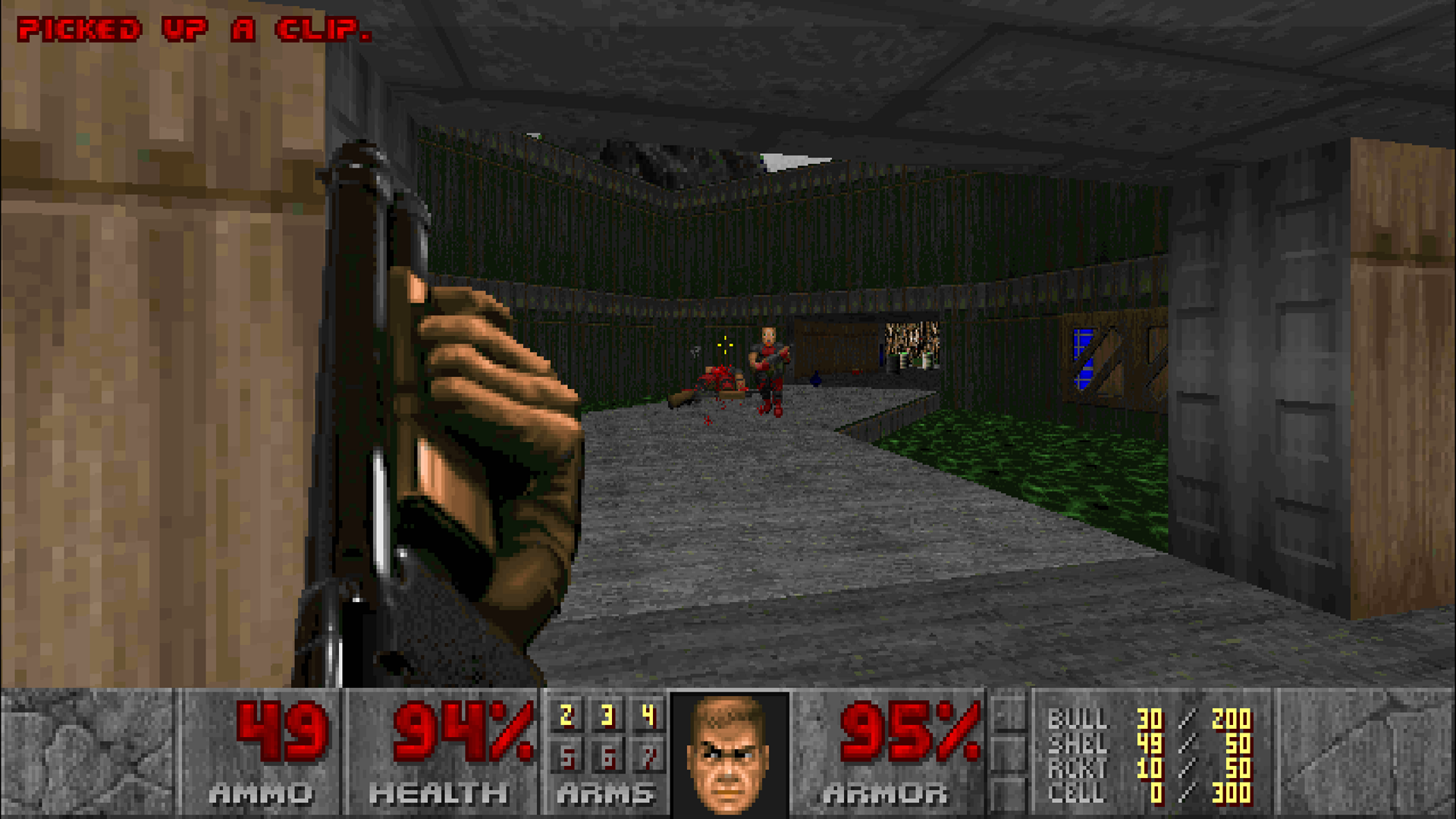
Another aspect of the game that I have left to nitpick would be the weapons. Yes, the BFG9000 is legendary, but every other weapon here felt like a heavy metal-ised Nerf gun. It doesn't help that the game runs on this strange ammo system where your gun seemingly has access to the vast storage of bullets you pick up without the need to reload. It did at times make the act of shooting feel less like a precision fighter, and more like a tedium where I need to hold down the trigger. Additionally, the guns felt tame here. The sound effects were explosive, and the enemy death animations were cool, but there is a lack of connection between those two instances that loses that badass effect. Besides those tiny issues, I heavily enjoyed using every gun here (except the pistol and chainsaw, they were beyond pointless), and while not top-tier, it's clear that the future games would do nothing but expand and improve upon the formula they had.
The last thing I want to critique is also the first thing I have genuine problems with: the level design. Hallways of confusion and rooms of misery are the best way to describe just how cluttered the level design felt here. I would get so absolutely lost in every level as the number of backtracking, unclear portals, secret rooms and more would daze me more than impress. To go from level to level, you have to find a keycard that leads to a room with another keycard, which then leads to the exit. The problem is, the passage between these keycards consists of a maze that isn't helped by the repeating textures and identical-looking hallways. Slap on the fact that when you die, you restart the whole level, losing all your weapons in the process (unless you save-scum), and you get moments where there's more dissatisfaction than motivation. This might sound like a skill issue, or me being bitter, but it did irreversibly dampen part of my experience with the game, and this flaw is particularly common with others, from what I've seen.
The biggest question I had while playing the game is: did it still hold up to the other FPS titans of today? While it does retain many of the qualities that make today's shooters so exhilarating, like the speed or the unique enemy variety, the combination of rusty level design and the fact that every shooter since has been expanded upon tenfold, does hold the game back a bit. Not by a terrible amount, as you can still find plenty of worthwhile hours here, but it's not enough for me to rank it so highly, quality-wise, as I am aware just how important the game is in terms of its legacy.
Bossfights
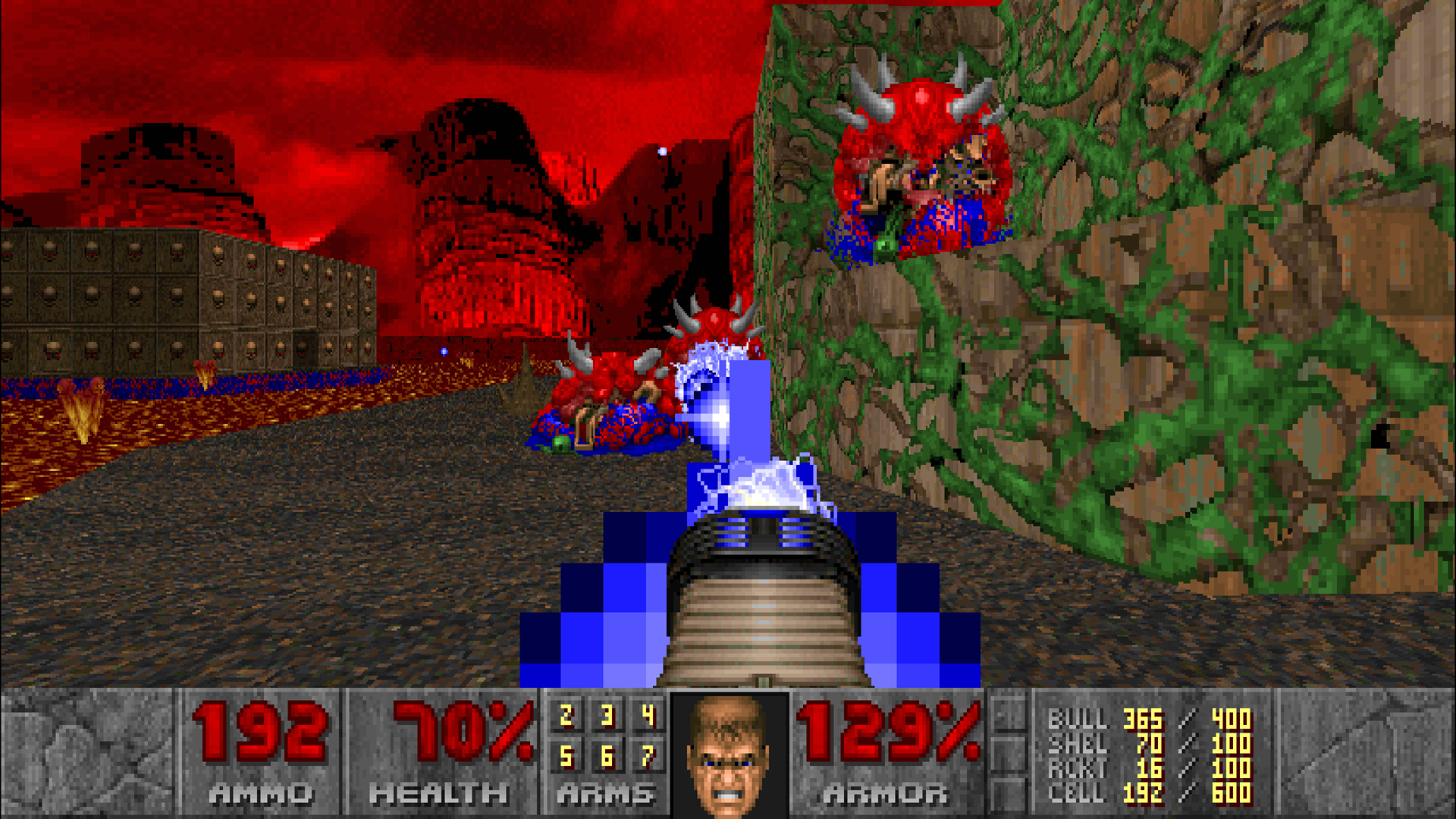
There are a total of three bossfights here that get repeated among the 4-episode structure. These three behemoths, for as eye-catching and mighty as they look, boil down to just being strong-hitting bullet-sponges. The Barons of Hell quickly lose their iconic status for me as they get rinsed and repeated as regular "elite" enemies after the first episode. The Cyberdemon and Spiderdemon, for as cool as they look, don't offer anything mechanically different from another that wowed me, and even if their designs are really cool, the arenas the fights take place in are either way too open or offer way too much cover, allowing for BFG spam shots to take place and end the fight early.
Atmosphere
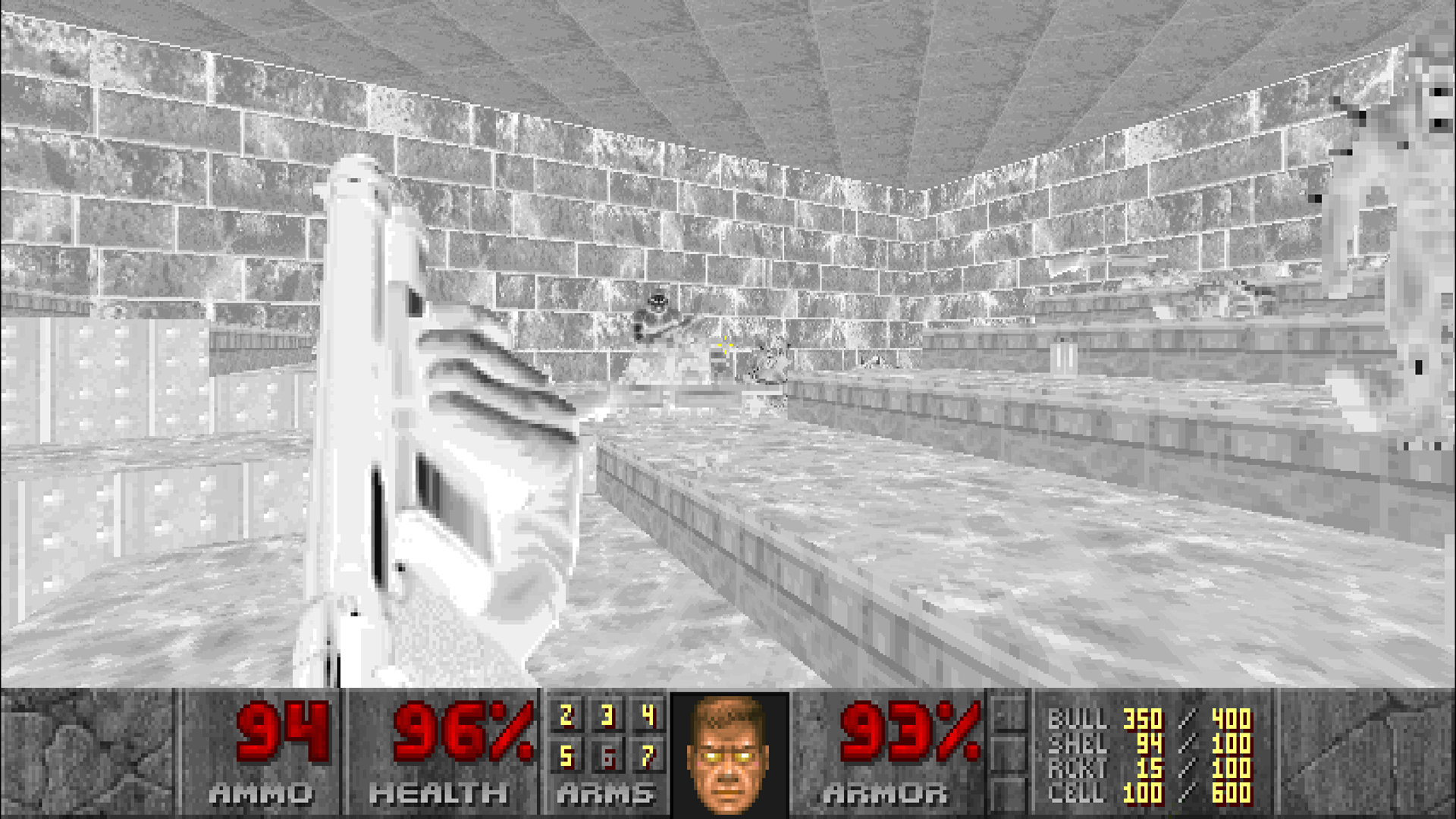
As expected from a game that has such a legendary status, part of it stems from just how iconic it looks and sounds. The incredibly varied enemy design is responsible for making the game look so visually elegant at times, despite the issue of repetition when it comes to the murky and somewhat unpleasant-looking wall and floor textures. Some environments counteract this by having a great-looking skybox, engaging structure of interiors and more, but most of the time, you're dealing with a heavy pixelation of fantastical enemies and meh, blocky arenas, that, when blended, work out to still give a decent appeal thanks to that old-school charm.
The music is awesome. I'm not much of a fan of heavy metal, but any 'Doom' soundtrack always makes me reconsider hard, especially when we're talking about the one that kickstarted this badass trend. It has all the needed staples of an action-packed game: it's blood-pumping, it's energetic, and it's potent enough to make you thrive in an environment of pure bloodbaths. There is some dark and eerie attunement to it, too, best related to the whole Hell vibe, and that kind of mix of sinister-sounding ambience and adrenaline-boosting music makes for an electrifying soundtrack. The audio for the enemies, firefights, etc, is equally solid. That added crunching of the audio gives the otherwise occasionally tame sound effects some more pizzazz and memorability.
Gameplay - 6.5/10
Bossfights - 5/10
Atmosphere - 8/10

Good
The setbacks it experiences in its design are suppressed just enough by the charm, and with just how smooth it feels to play.